
20 Apr Assistive listening technology: what are your options?
While many businesses know they should be considerate towards visible access issues like wheelchair use, hidden disabilities such as hearing impairment are often not given the same attention.
Hearing aids alone are simply not enough for people with hearing impairment. They pick up all sound in the surrounding area and don’t distinguish speech from background noise, which can make it difficult to easily interact in public spaces. Assistive listening technologies can notably enhance experiences in venues such as movie theatres, meeting halls, and churches for those who have been missing out for years.
What is an assistive listening device?
Assistive Listening Technology, or Assistive Listening Devices (ALDs), capture a sound source and transmit it directly to the person listening. There are three main types of ALDs:
Infrared light covers large areas and has a quick and simple installation, with signal reaching across the room as long as a line of sight is maintained with the transmitters. Users must ask for receivers, which can be off-putting for those who do not wish to highlight their hearing loss. All receivers must then be kept charged.
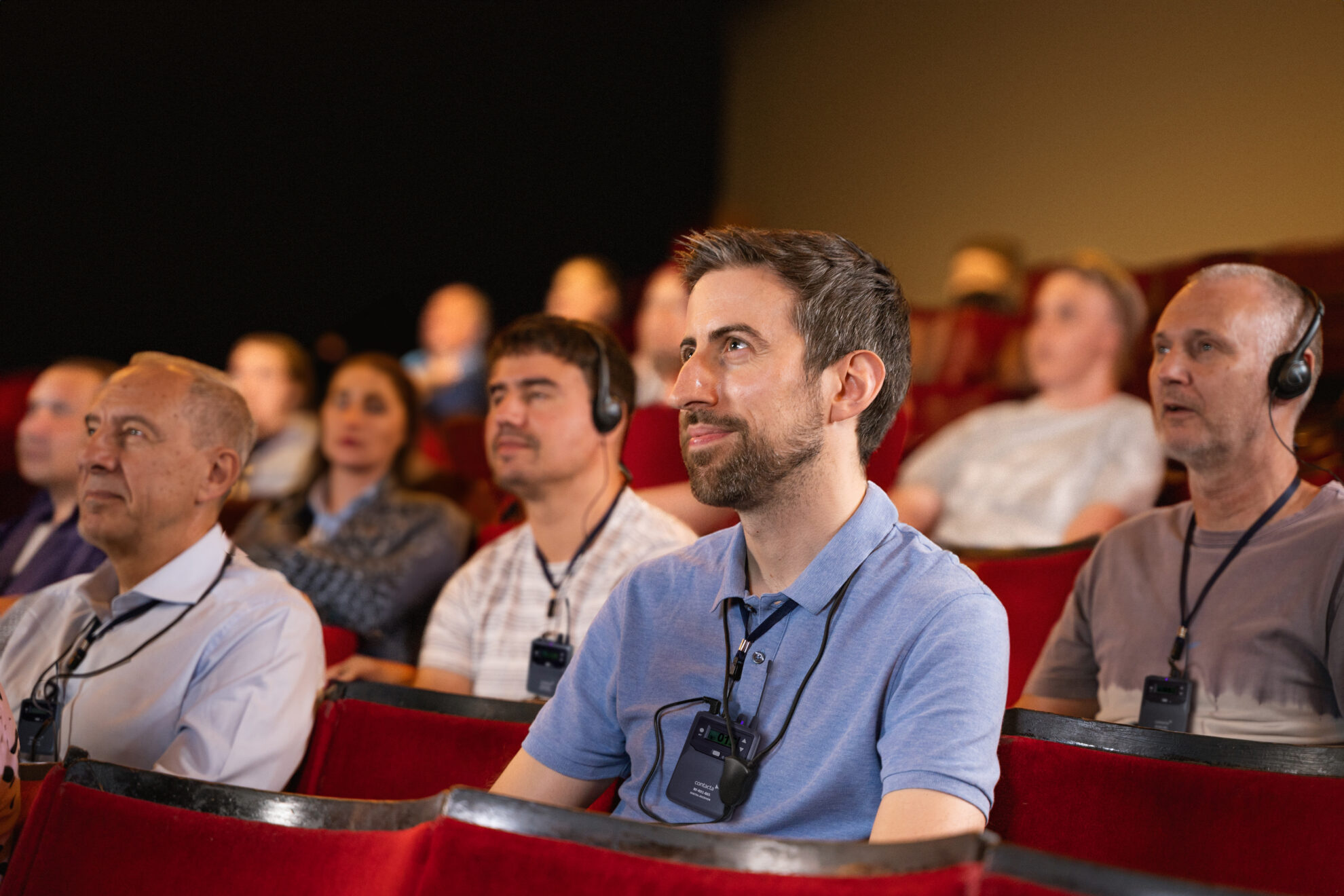
RF systems use radio frequencies to transmit directly to receivers or earphones when the user has a receiver, such as a Neckloop equipped. Unless they have a custom hearing aid, users will either carry their own equipment or, like with infrared, ask for receivers.
Hearing loops are universally compatible with the telecoil inside hearing devices, meaning no additional equipment needs to be worn by hearing aid wearers. Although they generally have a higher installation cost than other options, they are incredibly discreet once laid down, requiring very little maintenance (other than periodic checks).
What about Bluetooth for assistive listening?
Bluetooth is the most recent of these technologies and uses radio waves to connect to users’ smartphones or computers. Convenience is a benefit, as savvy users just need to bring their electronic device with them and connect wirelessly. The main drawback here is latency; there is a significant delay between when the sound is produced and when it reaches the listener, meaning that ‘real-time’ communication is a struggle. There is also the imperative that each user is required to own their own smartphone or device, as well as having it readily available and charged at any given time – this is often unrealistic.
Why are hearing loops so widely adopted?
We believe that hearing loops are the very best all-around Assistive Listening Technology, due to both their lack of latency and ease of use. These benefits have been demonstrated to users around the world, as hearing loops are the most widely adopted assistive listening technology option globally.

Contacta launches next-generation RF system for assistive listening
For venues where radio frequency assistive listening is the right fit, Contacta’s latest RF assistive listening systems are now available. This all-new range includes powerful transmitters, wireless receivers and accessories that offer improved performance and new advanced features to provide assistive listening in a wide variety of venues and for tour guidance.
Why choose RF systems?
Radio frequency technology has the following advantages over other types of assistive listening equipment:
- Simpler integration: RF transmitters can be fitted into any venue post-construction without complex physical installation.
- Flexibility: These systems can be used in venues such as stadiums, boardrooms, museums and conventions as the radio signal can pass through walls and partitions. It is also suitable for outdoor use.
- Quality sound: A wider frequency bandwidth and improved audio reproduction make the new RF system ideal for both speech and music.
- Convenience: Users can connect to transmitters hands-free and by wearing headphones or inductive neck loops.
Contacta RF 865
Our new RF systems go beyond the performance of their predecessors. They benefit from:
- Increased transmission range: Extensive coverage that allows listeners to roam freely, utilising 42 channels.
- Fast group programming: Quick set-up of groups of receivers with PC compatibility and new Smart Chargers.
- Improved sound quality: Wider frequency bandwidth up to 12KHz delivers excellent sound quality.
- Improved audio connectivity: Balanced XLR inputs, Phantom Power and Inbound Bluetooth streaming utilising two parallel inputs. Dante Transmitters now available (from June 2024).
- All-new handheld mic transmitter, ideal for educational applications.
- Improved transmission range using a more reliable 865MHz frequency to increase predictability of signal.
Inclusivity and accessibility are vital
Ready to break down communication barriers in your business with our RF technology?
Learn more about the exciting possibilities our systems offer by clicking here or click here to get in touch TODAY.
Contacta is here to help your business create inclusive environments with our superior assistive listening technology.
 MADE IN THE UK: We’re proud to say our Contacta designed products are manufactured in the UK