
02 Feb “We pull together to produce fantastic products.”
Hannah Eastwell on hearing loops, innovation, and why established technology still leads
Most industries are well aware of the need to create spaces that are entirely accessible. The focus is now shifting to environments that are inclusive and integrate everyone’s needs, regardless of the scale or function of the space.
Assistive listening technology is an essential part of inclusive design to make sure public buildings offer access to the 1 in 6 of the population who have hearing loss.
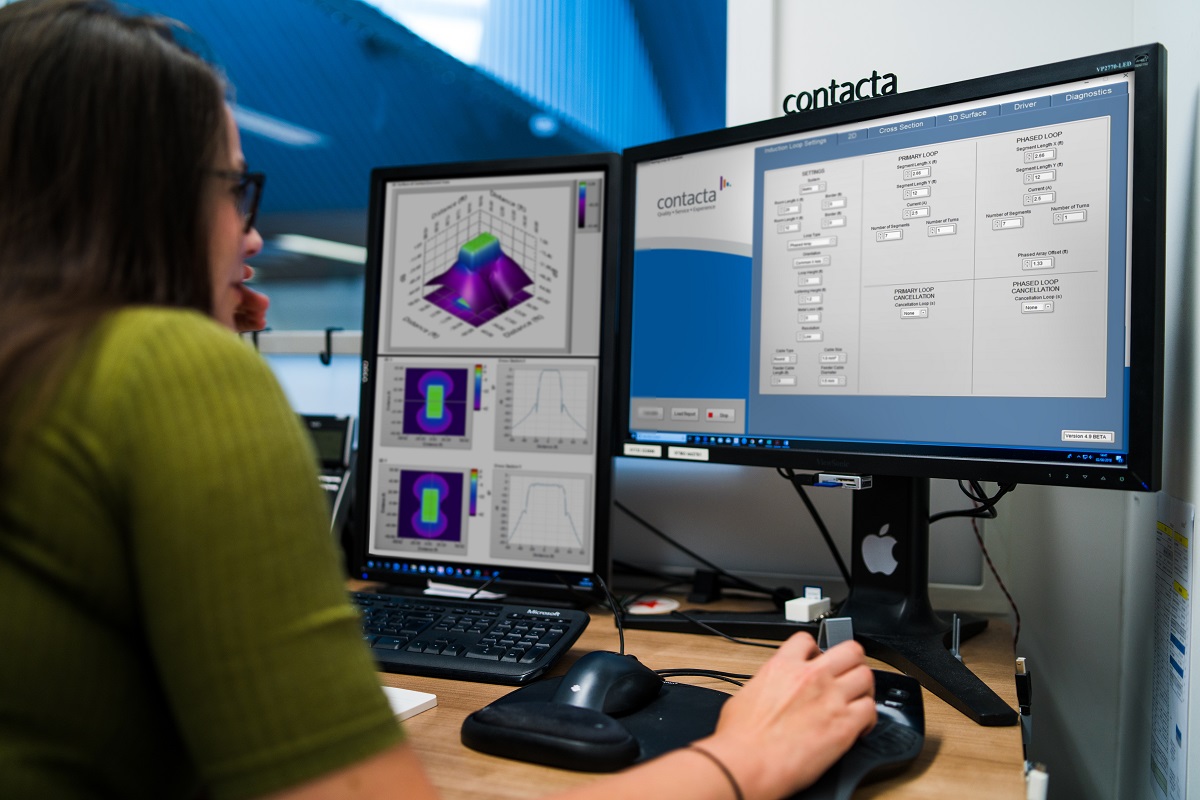
Contacta is well-known for our product innovation and for creating high-performance, user-friendly assistive listening systems. These assets have helped us to maintain our position as a market leader for much of our 50-year history. Leading that innovation is Product Development Manager, Hannah Eastwell. Her role is to oversee products from their initial concept through to installation.
While Contacta is synonymous with hearing loops and window intercom systems, Hannah and her team are also responsible for making sure the company’s queue management systems and security products meet the needs of customers.
A new perspective on assistive listening
“I truly enjoy every aspect of my job,” says Hannah. “The initial concept and design stages are always fun, and testing the product with users and gaining external approvals is always very rewarding.
“Ultimately, hearing customer or users’ feedback about how well the product is performing or how the technology is improving their accessibility is fantastic.”
Hannah had no experience with assistive listening technology when she first joined Contacta, which she says gave her a unique objectivity. “I didn’t have any pre-conceptions about what products could do or should look like, so I was able to bring new ideas to the design process.”
That mix of innovation and real-world accessibility matters because, with a range of solutions now available, it can be tempting to think that well-established technologies, like hearing loops, may be out of date or that installing them now would be a waste of time and money. Specifiers can sometimes be reluctant to install these systems for fear they will be superseded by one of the burgeoning digital technologies in the very near future.
However, that’s simply not the case.
Hearing loops are “old” technology for a reason
Induction or hearing loops are a staple of technology which originated in the 1950s, but despite its age, it still offers the best solution available. They are the easiest system to use and the only one which is truly universal. Much like the wheel, there is very little need to reinvent a successful mechanism.
Hearing loop systems consist of copper cables, often concealed around the perimeter of a room, that transmit electromagnetic signals from a microphone or other sound source. Telecoil couplers are small copper wire coils integrated into most hearing aids and cochlear implants. They pick up these electromagnetic signals, which enable the user to hear the sound source clearly, cutting out distracting background noise.
For example, a delegate attending a conference may struggle to hear the presentation because of distance, reverberation and background noise in the room. With a hearing loop, they are able to hear the speaker’s voice clearly and distinctly.
What’s more, their energy efficiency means they can be continually running, giving users access at any given time. They are also universal, so no matter where in the world the hearing aid wearer comes from, they will be able to use them. Hearing Loops also have no latency issue, which is critical when following an event where images or actions come together with sound. Even a small delay (of half a second or so) can be tremendously distracting and disorientating for the user, so this is a critical distinction.
Infrared and radio frequency systems are also widely used. These can cover large areas and are easier to retrofit, but they do require accessories for the user to receive the sound. Their range can also be affected by bright sunlight, glass surfaces or congestion on the bandwidth the system is using, making them unfit for some applications.
Bluetooth offers wireless communication and its development already gives people with hearing loss a number of benefits. However, these are currently only on a personal level and not for large groups, or one-to-one situations, in public spaces. Bluetooth can amplify the television or audio sources for users at home, and smartphone apps allow levels in their hearing aids to be altered with one touch.
But the accessories and the hearing aids have to be compatible, and not all brands can seamlessly integrate, making them unsuitable for groups of people. The industry is working on developing a system that will offer standardised Bluetooth technology to allow people with hearing aids to connect to smart devices. An agreement was formed between the European Hearing Instrument Manufacturers Association (EHIMA) and Bluetooth Special Interest Group in 2014 to work together towards this.
However, Bluetooth’s development into a system that can serve groups of people in large areas is some way off. According to the International Hearing Access Committee, a body comprising hearing aid manufacturers and consumer organisations, there’s unlikely to be a significant change within the next 10 to 15 years and beyond. As well as a consensus needing to be reached on the preferred system, it would need to be thoroughly tested and then widely adopted before it could be regarded as mature and fit for use. A bandwidth for the signal to use would also need to be agreed.
What can’t wait? Fulfilling the Equality Act
In the meantime, public buildings have an immediate imperative to comply with the requirements of the Equality Act and, ideally, the best practice recommendations for creating inclusive spaces as contained in BS8300.
Hearing loops offer a simple and effective way to offer hearing access, and when installed by a specialist engineer, they transform communication at hotel reception desks, conference rooms, at a retail service counter, in a theatre auditorium or a place of worship.
Totalling 11 million, people with hearing loss constitute the largest disabled group in the UK. With an ageing population, their numbers will continue to grow, so there is a clear business case for meeting their needs – ensuring that hearing loops will not be a wasted investment, whether you’re planning for a new build or retrofit.
Proud moments in product development
One of Hannah’s proudest achievements is the development of the V PRO range of large area hearing loop drivers, which was shortlisted for an industry award.
“We designed a range of the most technologically advanced drivers, and yet they’re some of the simplest to install and operate. It was an honour being able to work on such a product,” she said.
The power of teamwork during and post-pandemic
Hannah now leads a department of four staff. Their designs are influenced by the needs of customers, but the greatest change in the team’s development focus came when Hannah was on maternity leave.
“Before I went off to have my little girl, we were working on the V22,” she remembers. “Then COVID hit, and when I came back, work was focused on new additions to our window intercom systems.”
The team created the STS-K070 range, entry-level window intercoms for businesses like care homes that suddenly found they needed a way of creating clear conversation through protective screens. The design team had to react and deliver in record time to be able to respond effectively to the impact of the pandemic.
“At Contacta, we’re very lucky to be able to pull together in unison to produce fantastic products. I have a great team of experienced and talented electronics engineers.”
Hannah is understandably proud of their achievements and they are close to bringing their latest design, Contacta’s first-ever IP-rated window intercom system for outdoor venues, to market. Ingress protection testing saw the product, which she designed and guided the development of, achieving an excellent rating of IP-55.
“It’s always been very important to me to know that my work has a positive impact. Knowing that our products are giving people a better hearing experience and greater accessibility is fantastic.”
 MADE IN THE UK: We’re proud to say our Contacta designed products are manufactured in the UK